Get Real Mixed Martial Arts & Fighting Skills Here


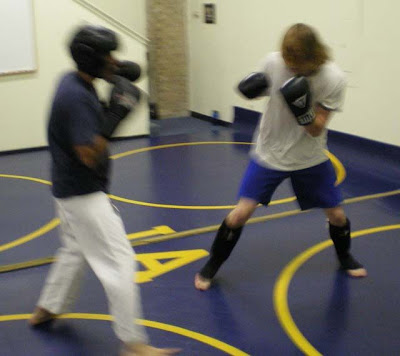
Integrated Fighting Arts (IFA) Academy, located (above) three blocks west of the University of Texas (UT) Austin campus, specializes in detailed instruction in Boxing, Kickboxing, Brazilian Jiu-Jitsu (BJJ), Submission Grappling, Wrestling, Mixed Martial Arts (MMA), and Filipino Martial Arts. Since 1990, our academy welcomes anyone interested in attaining realistic fighting skills, getting in great physical condition, and having a lot of fun in the process.

Feel free to stop by our academy, during class times (right), to check out our classes, or contact us for further information.

IFA Academy Blog

Tuesday, December 16, 2008

Boxing: Using The Uppercut, Cross, Hook Punch Combination As Your Opponent Slips Your Cross

In this video, Chief Instructor Frank Benn demonstrates how and when to utilize the uppercut, to set up your opponent for a cross and hook punch follow-up.


http://www.youtube.com/watch?v=5KQZg_9H1Po

Read More...

Tuesday, December 9, 2008

Filipino Martial Arts: Using The "Roof" Stick Block To Obtain A "Snake" Disarm

In this video, Chief Instructor Frank Benn demonstrates how to use the "roof" block, in Filipino Martial Arts stickfighting, to obtain a "snake" disarm of an opponent's weapon. He also gives keys to how to make it work, and what happens when these points aren't followed.


http://www.youtube.com/watch?v=HJHngjufUNo

Read More...

Saturday, November 29, 2008

Kickboxing: Footwork & Delivery In Kicking Part II

In this second video, of a two-part video series, Chief Instructor Frank Benn demonstrates how to use effective footwork in and proper delivery of kicking. This video covers how the range between you and your opponent affects how you set-up and deliver your kicks.


http://www.youtube.com/watch?v=FXtvr4QKstA

Read More...

Saturday, November 22, 2008

Kickboxing: Footwork & Delivery In Kicking Part I

In this first video, of a two-part video series, Chief Instructor Frank Benn demonstrates how to use effective footwork in and proper delivery of kicking. This video covers how to draw out an opponent's defense to set up your kicks, and a brief explanation of the "hierarchy of offense" and how punching and kicking fits into it.

http://www.youtube.com/watch?v=aWj27tH91RA

Read More...

Tuesday, November 4, 2008

Striking With The Knee Part 3

In this third video, of a three-part video series, Chief Instructor Frank Benn demonstrates how to utilize footwork, posture, and body control, to deliver knee strikes from the clinch.

http://www.youtube.com/watch?v=YE6uaA8VyOQ

Read More...

Thursday, October 30, 2008

Striking With The Knee Part 2

In this second video, of a three-part video series, Chief Instructor Frank Benn demonstrates how to utilize footwork, posture, and body control, to deliver knee strikes from the clinch.

http://www.youtube.com/watch?v=i5D0M0G0r-w

Read More...

Saturday, October 25, 2008

Striking With The Knee Part 1

In this first video, of a three-part video series, Chief Instructor Frank Benn demonstrates how to utilize footwork, posture, and body control, to deliver knee strikes from the clinch.

http://www.youtube.com/watch?v=KGbc5VNyNwc

Read More...

Thursday, October 23, 2008

MMA: Using MMA For Self-Defense Part 5

In this fifth video, of a five-part video series, Chief Instructor Frank Benn demonstrates how to use the techniques learned in mixed martial arts training, in self-defense situations, potentially when an opponent is bigger, or stronger.

http://www.youtube.com/watch?v=rLLNPGnlc0A

Read More...

Monday, October 20, 2008

MMA: Using MMA For Self-Defense Part 4

In this fourth video, of a five-part video series, Chief Instructor Frank Benn demonstrates how to use the techniques learned in mixed martial arts training, in self-defense situations, potentially when an opponent is bigger, or stronger.

http://www.youtube.com/watch?v=rVEOC9E3xUk

Read More...

Friday, October 17, 2008

MMA: Using MMA For Self-Defense Part 3

In this third video, of a five-part video series, Chief Instructor Frank Benn demonstrates how to use the techniques learned in mixed martial arts training, in self-defense situations, potentially when an opponent is bigger, or stronger.

http://www.youtube.com/watch?v=DrxFobHt61c

Read More...

Tuesday, October 14, 2008

Grappling: Integrating Wrestling & Jiu-Jitsu Part 4

In this final video, of a four-part video series, Chief Instructor Frank Benn demonstrates how to integrate wrestling and jiu-jitsu to implement superior grappling into your game. This fourth video deals with how to counter a double-leg takedown attempt, when unable to sprawl, by using a "sacrifice" elevator to obtain a kimura submission.

http://www.youtube.com/watch?v=Jv3MDeaZOEw

Read More...

Monday, October 13, 2008

Boxing: Developing Footwork

In this video, Chief Instructor Frank Benn demonstrates how to set up striking combinations off of the uppercut punch.


http://www.youtube.com/watch?v=dlmY8Ask9yw

Read More...

Saturday, October 11, 2008

Grappling: Integrating Wrestling & Jiu-Jitsu Part 3

In this third video, of a four-part video series, Chief Instructor Frank Benn demonstrates how to integrate wrestling and jiu-jitsu to implement superior grappling into your game. This third video deals with how to counter a double-leg takedown attempt, when unable to sprawl, by using a "sacrifice" elevator to obtain the mount position.

http://www.youtube.com/watch?v=NMhzyPKqbPA

Read More...

Thursday, October 9, 2008

Boxing: Refining The Cross, Elliptical Versus Linear Path

In this video, Chief Instructor Frank Benn demonstrates why using an elliptical path (versus a linear path) makes your cross punch faster and more efficient.


http://www.youtube.com/watch?v=llghREA_D8A

Read More...

Wednesday, October 8, 2008

Grappling: Leg Entangled Armlock From Scarf Hold

In this video, Chief Instructor Frank Benn demonstrates how to secure various armlocks (Americana, straight armlock) using the legs from the scarf hold (kesa gatame).

http://www.youtube.com/watch?v=jzKXCkR7bwY

Read More...

Tuesday, October 7, 2008

Boxing: Alternate Targeting

In this video, Chief Instructor Frank Benn demonstrates how to adapt your boxing offense, to create and exploit openings in your opponent's defense.


http://www.youtube.com/watch?v=SzVa1RE1Xus

Read More...

Sunday, October 5, 2008

Grappling: Integrating Wrestling & Jiu-Jitsu Part 2

In this second video, of a four-part video series, Chief Instructor Frank Benn demonstrates how to integrate wrestling and jiu-jitsu to implement superior grappling into your game. This second video deals with how to use a dresser dump off of a front head-lock, to setup a cross arm-lock submission.

http://www.youtube.com/watch?v=G-Eun8-kRes

Read More...

Saturday, October 4, 2008

MMA: Using MMA For Self-Defense Part 2

In this second video, of a five-part video series, Chief Instructor Frank Benn demonstrates how to use the techniques learned in mixed martial arts training, in self-defense situations, potentially when an opponent is bigger, or stronger.

http://www.youtube.com/watch?v=Tm_3PMty2xw

Read More...

Friday, October 3, 2008

MMA: Using MMA For Self-Defense Part 1

In this first video, of a five-part video series, Chief Instructor Frank Benn demonstrates how to use the techniques learned in mixed martial arts training, in self-defense situations, potentially when an opponent is bigger, or stronger.

http://www.youtube.com/watch?v=9UNIwQC2PMA

Read More...

Thursday, October 2, 2008

Grappling: Integrating Wrestling & Jiu-Jitsu Part 1

In this first video, of a four-part video series, Chief Instructor Frank Benn demonstrates how to integrate wrestling and jiu-jitsu to implement superior grappling into your game. This first video deals with how to apply the double-arm whizzer wrestling defense and transition into a cross arm-lock submission.

http://www.youtube.com/watch?v=5v-uoiJxvdE

Read More...

Wednesday, October 1, 2008

Boxing: Building Combinations With The Uppercut

In this video, Chief Instructor Frank Benn demonstrates how to set up striking combinations off of the uppercut punch.


http://www.youtube.com/watch?v=Q6Ci4KIZI6c

Read More...

Monday, September 29, 2008

Grappling: The Significance of the Underhook in Wrestling & Jiu-Jitsu Part 4

In this final video, of a four-part video series, Chief Instructor Frank Benn demonstrates the significance of the underhook in wrestling and jiu-jitsu (BJJ).

http://www.youtube.com/watch?v=zKlUxE7bG-Y

Read More...

Saturday, September 27, 2008

Boxing: Developing "Pop" In The Uppercut & Shovel Punch

In this video, Chief Instructor Frank Benn demonstrates how to develop "pop" in the uppercut and shovel punches.


http://www.youtube.com/watch?v=_aDgzzzYdhA

Read More...

Friday, September 26, 2008

Grappling: The Significance of the Underhook in Wrestling & Jiu-Jitsu Part 3

In this third video, of a four-part video series, Chief Instructor Frank Benn demonstrates the significance of the underhook in wrestling and jiu-jitsu (BJJ).

http://www.youtube.com/watch?v=mipHUKGXPHM

Read More...

Thursday, September 25, 2008

Filipino Martial Arts: Basic Knife Defense Part 2 Realism In Training & Using Your Environment

In this second video, of a two-part video series, Chief Instructor Frank Benn discusses realism in training knife defense, and considering your surroundings when faced with a knife attack.

http://www.youtube.com/watch?v=0a3K8gPHCco

Read More...

Wednesday, September 24, 2008

Boxing: The Descending & Ascending Hook

In this video, Chief Instructor Frank Benn demonstrates how to utilize the descending and ascending hook punches.


http://www.youtube.com/watch?v=BgZU8yyLTzI

Read More...

Tuesday, September 23, 2008

Grappling: Cross Armlock From Back Mount

In this video, Chief Instructor Frank Benn demonstrates how to transition to the cross armlock from the back mount.

http://www.youtube.com/watch?v=paMRVvfFE9s

Read More...

Monday, September 22, 2008

Filipino Martial Arts: Basic Knife Defense Part 1 Strategies & Techniques

In this first video, of a two-part video series, Chief Instructor Frank Benn demonstrates strategies and techniques to deal with knife attacks.

http://www.youtube.com/watch?v=pNe8z3lA6Jk

Read More...

Saturday, September 20, 2008

Grappling: The Significance of the Underhook in Wrestling & Jiu-Jitsu Part 2

In this second video, of a four-part video series, Chief Instructor Frank Benn demonstrates the significance of the underhook in wrestling and jiu-jitsu (BJJ).

http://www.youtube.com/watch?v=6zcAQmMIlH8

Read More...

Wednesday, September 17, 2008

Grappling: The Significance of the Underhook in Wrestling & Jiu-Jitsu Part 1

In this first video, of a four-part video series, Chief Instructor Frank Benn demonstrates the significance of the underhook in wrestling and jiu-jitsu (BJJ).

http://www.youtube.com/watch?v=3O1AuprlTnU

Read More...

Monday, September 15, 2008

Filipino Martial Arts: The Crossada Part 2 Follow-Up Attacks

In this second video, of a two-part video series, Chief Instructor Frank Benn demonstrates how to use follow-up attacks, off of the open and closed crossada doble baston (double stick) techniques, found in Filipino Martial Arts/Escrima.

http://www.youtube.com/watch?v=HhxpTen176k

Read More...

Sunday, September 14, 2008

Grappling: Back Triangle Choke From Failed Cross Armlock

In this video, Chief Instructor Frank Benn demonstrates how to secure the back triangle choke, off of a failed cross armlock attempt.

http://www.youtube.com/watch?v=si6MEci6Yc0

Read More...

Friday, September 12, 2008

Filipino Martial Arts: The Crossada Part 1 Fundamentals

In this first video, of a two-part video series, Chief Instructor Frank Benn demonstrates how to use the open and closed crossada doble baston (double stick) techniques, found in Filipino Martial Arts/Escrima.

http://www.youtube.com/watch?v=DOiyk8gw5PQ

Read More...

Thursday, September 11, 2008

Grappling: Inverted Cross Armlock From Guard Part 3

In this final video, of a three-part video series, Chief Instructor Frank Benn demonstrates techniques to obtain the inverted cross arm-lock (armbar) from guard.

http://www.youtube.com/watch?v=FiJFLtJp67I

Read More...

Monday, September 8, 2008

Grappling: Inverted Cross Armlock From Guard Part 2

In this second video, of a three-part video series, Chief Instructor Frank Benn demonstrates techniques to obtain the inverted cross arm-lock (armbar) from guard.

http://www.youtube.com/watch?v=EeYn1eD99I0

Read More...

Friday, September 5, 2008

Grappling: Inverted Cross Armlock From Guard Part 1

In this first video, of a three-part video series, Chief Instructor Frank Benn demonstrates techniques to obtain the inverted cross arm-lock (armbar) from guard.

http://www.youtube.com/watch?v=HFf0ot0zI3k

Read More...

Tuesday, September 2, 2008

Grappling: Arm & Neck Choke Part 2

In this second video, of a two-part video series, Chief Instructor Frank Benn demonstrates how to secure the arm and neck choke from dominant position (mount, sit-out), along with a cross armlock follow-up submission.

http://www.youtube.com/watch?v=GLV_iAVKa60

Read More...

Saturday, August 30, 2008

Grappling: Arm & Neck Choke Part 1

In this first video, of a two-part video series, Chief Instructor Frank Benn demonstrates how to secure the arm and neck choke using various transitions from the guard.

http://www.youtube.com/watch?v=96cUv1G7BoI

Read More...

Thursday, August 28, 2008

Grappling: Side Triangle Choke From Under Side Control

Chief Instructor Frank Benn demonstrates how to obtain the side triangle choke while under side control.


http://www.youtube.com/watch?v=s0x-kqqV0qg

Read More...

Tuesday, August 26, 2008

Grappling: Guard Defense Against The Pass Part 5

IFA Academy (IFAacademy.com, Austin, TX) In this final video, of a five-part series, Chief Instructor Frank Benn demonstrates how to retain the guard, using another of the 25 essential guard skills trained at IFA Academy.


http://www.youtube.com/watch?v=qlT0uSp_fPM

Read More...

Saturday, August 23, 2008

Grappling: Guard Defense Against The Pass Part 4

IFA Academy (IFAacademy.com, Austin, TX) In this fourth video, of a five-part series, Chief Instructor Frank Benn demonstrates how to retain the guard, using another of the 25 essential guard skills trained at IFA Academy.


http://www.youtube.com/watch?v=5CBuGnvHPHs

Read More...

Tuesday, August 19, 2008

Grappling: Guard Defense Against The Pass Part 3

IFA Academy (IFAacademy.com, Austin, TX) In this third video, of a five-part series, Chief Instructor Frank Benn demonstrates how to retain the guard, using another of the 25 essential guard skills trained at IFA Academy.


http://www.youtube.com/watch?v=RJ9Dd1her7A

Read More...

Wednesday, August 13, 2008

Grappling: Guard Defense Against The Pass Part 2

IFA Academy (IFAacademy.com, Austin, TX) In this second video, of a five-part series, Chief Instructor Frank Benn demonstrates how to retain the guard, using another of the 25 essential guard skills trained at IFA Academy.


http://www.youtube.com/watch?v=Anei01LnvFM

Read More...

Saturday, August 9, 2008

Grappling: Guard Defense Against The Pass Part 1

IFA Academy (IFAacademy.com, Austin, TX) In this first video, of a five-part series, Chief Instructor Frank Benn demonstrates how to retain the guard, using one of the 25 essential guard skills trained at IFA Academy.


http://www.youtube.com/watch?v=tOaU5BnrsW4

Read More...

Tuesday, July 29, 2008

Grappling: Submission Grappling Flow 02

In this video, Chief Instructor Frank Benn demonstrates a chain submission and positional grappling flow containing the following: Passing Guard, Side Control B, North South Position, Kimura, Cross Arm-Lock.


http://youtube.com/watch?v=jVsEetqZZow

Read More...

Thursday, July 24, 2008

Grappling: Submission Grappling Flow 01

In this video, Chief Instructor Frank Benn demonstrates a chain submission and positional grappling flow containing the following: Double-Leg Takedown, Side Control, Knee-Elbow Escape, Guard, Cross Arm-Lock, Figure 4 Counter.


http://youtube.com/watch?v=QSJuBStzYd0

Read More...

Wednesday, July 16, 2008

Boxing/Kickboxing: Reflex Partner Drill

In this video, Chief Instructor Frank Benn demonstrates a boxing / kickboxing reflex development partner drill, using the jab, cross, block, Thai round kick, and shin check/block.


http://youtube.com/watch?v=UGHn4VdQuyw

Read More...

Saturday, July 12, 2008

Clinch Prevention & Countering

In this video, Chief Instructor Frank Benn demonstrates techniques and strategies to prevent and counter clinching by an opponent.


http://youtube.com/watch?v=ahl22IHc0d4

Read More...

Friday, July 4, 2008

Boxing: Reflex Partner Drill

In this video, Chief Instructor Frank Benn demonstrates a boxing reflex development partner drill, using the jab, cross, hook, parry, slip, and block. Useful in developing counter-attack reactions, to turn the tide against an opponent's attack.


http://youtube.com/watch?v=7tXvW-8hODg

Read More...

Monday, June 30, 2008

Boxing: When To Use The Rear Uppercut

In this video, Chief Instructor Frank Benn demonstrates how and when to use the rear uppercut punch.


http://youtube.com/watch?v=mZnKQmX4U_wg

Read More...

Saturday, June 28, 2008

Grappling: Passing Guard to Top Control and Finishing Part 4

In this final video, of a four-part series, Chief Instructor Frank Benn demonstrates how to pass the guard to top control and finishes using a chain submission and positional grappling flow containing the following: Guard Pass without Superior Arm Position, Whizzer, Quarter Nelson, Side Control.


http://youtube.com/watch?v=W-h6E7L-mO8

Read More...

Thursday, June 26, 2008

Grappling: Passing Guard to Top Control and Finishing Part 3

In this third video, of a four-part series, Chief Instructor Frank Benn demonstrates how to pass the guard to top control and finishes using a chain submission and positional grappling flow containing the following: Blocked Guard Pass (Shin Across Thigh), Knee Tap Guard Pass, Single-Leg Takedown, Sprawl, Whizzer, Front Head Lock, Go Behind.


http://youtube.com/watch?v=mS3XM0IeF_4

Read More...

Wednesday, June 25, 2008

Grappling: Passing Guard to Top Control and Finishing Part 2

In this second video, of a four-part series, Chief Instructor Frank Benn demonstrates how to pass the guard to top control and finishes using a chain submission and positional grappling flow containing the following: Blocked Guard Pass (Shin Across Thigh), Knee Tap Guard Pass, Side Control, North/South Position, Kimura, Cross Arm-Lock.


http://youtube.com/watch?v=NN2x0xlkRB0

Read More...

Tuesday, June 17, 2008

Grappling: Passing Guard to Top Control and Finishing Part 1

In this first video, of a four-part series, Chief Instructor Frank Benn demonstrates how to pass the guard to top control and finishes using a chain submission and positional grappling flow containing the following: Guard Pass (Shin Across Thigh), Modified Scarf Hold, Underhook, Cross Arm-Lock, Triangle Choke.


http://youtube.com/watch?v=QpiCBuXu78E

Read More...

Friday, June 13, 2008

Grappling: Guard Pass Defense To Cradle And Bridge

In this video, Chief Instructor Frank Benn how to defend a guard pass, bridge the opponent, and secure a cradle position.


http://youtube.com/watch?v=C4t8mf9laNQ

Read More...

Wednesday, June 11, 2008

Boxing: Combining Defensive Motions, Building Into Offense

In this video, Chief Instructor Frank Benn demonstrates how to combine boxing defensive motions, so that one may build into a counter-offensive on an opponent.


http://www.youtube.com/watch?v=_hzA7BuOz_g

Read More...

Tuesday, June 10, 2008

MMA: Snatch Single-Leg Off Counter Hook, Dump

In this video, Chief Instructor Frank Benn demonstrates how to get a single-leg takedown (dump), off of an opponent's counter hook.


http://youtube.com/watch?v=worCJBkrS3g

Read More...

Monday, June 9, 2008

Grappling: Knee-Bar Setup Off of Countering The Back Bear-Hug

In this final video, of a four-part series, Chief Instructor Frank Benn demonstrates how to secure the knee-bar as a counter to a back bear-hug.


http://youtube.com/watch?v=0xPxsxQUYw4

Read More...

Sunday, June 8, 2008

Grappling: Knee-Bar Setup From The Guard

In this third video, of a four-part series, Chief Instructor Frank Benn demonstrates how to secure the knee-bar from the guard.


http://youtube.com/watch?v=Hu7DpZzWC8g

Read More...

Saturday, June 7, 2008

MMA: Feinting The Shot and Changing Level To Connect A Cross Hook Cross Boxing Combo

In this video, Chief Instructor Frank Benn demonstrates how to deliver a cross-hook-cross (2-3-2) boxing combo on an opponent, by feinting a wrestling shot and changing level.


http://youtube.com/watch?v=l0br1HcXAO4

Read More...

Monday, June 2, 2008

Grappling: Knee-Bar Setup While Passing The Guard

In this second video, of a four-part series, Chief Instructor Frank Benn demonstrates how to secure the knee-bar while passing the guard.


http://youtube.com/watch?v=8cWU0ZHMWJU

Read More...

Thursday, May 29, 2008

Grappling: Knee-Bar Setup From Inside Half Guard

In this first video, of a four-part series, Chief Instructor Frank Benn demonstrates how to secure the knee-bar from inside the half guard.


http://youtube.com/watch?v=PGByUwCGICg

Read More...

Sunday, May 25, 2008

Boxing: Defending & Countering The Hook

Chief Instructor Frank Benn demonstrates techniques and strategy on how to defend and counter the hook punch.


http://youtube.com/watch?v=07sodXOw6GQ

Read More...

Saturday, May 24, 2008

Grappling: Countering The Single-Leg With A Rolling Omaplata

Chief Instructor Frank demonstrates how to counter the single-leg takedown, using the rolling omaplata submission.


http://youtube.com/watch?v=VHXfraKN4zY

Read More...

Friday, May 23, 2008

Bicep Crush From Guard With Follow-Ups

Chief Instructor Frank Benn demonstrates how to secure the bicep crush from the guard, with triangle choke and omaplata follow-up submissions.


http://youtube.com/watch?v=YXIUF5J9Wow

Read More...

Wednesday, May 21, 2008

Preventing The Triangle Choke

Chief Instructor Frank Benn demonstrates techniques and strategy to prevent the completion the triangle choke.


http://youtube.com/watch?v=UO6EZR60EXg

Read More...

Sunday, May 11, 2008

Boxing: How To Use The Slip And Parry

Chief Instructor Frank Benn demonstrates how to use the slip and parry in boxing.


http://youtube.com/watch?v=zvAhof-_CLg

Read More...

Friday, May 9, 2008

The "Chain Submission" Mindset From The Guard

Chief Instructor Frank Benn demonstrates how to utilize a "chain submission" strategy, when attacking your opponent from the guard.


http://youtube.com/watch?v=t3FTyUYYwpg

Read More...

Wednesday, May 7, 2008

How To Finalize The Triangle Choke

Chief Instructor Frank Benn demonstrates how to finalize the triangle choke.


http://youtube.com/watch?v=WlKKFMPJUWY

Read More...

Saturday, May 3, 2008

Boxing: Creating Openings Part 4

In this final video, of a four-part series, Chief Instructor Frank Benn demonstrates how to create and exploit openings in your opponent's boxing. This clip covers how to slip inside a jab and lead hook, when an opponent drops the rear hand while jabbing.


http://youtube.com/watch?v=FMbJGw-h_LE

Read More...

Thursday, April 24, 2008

Boxing: Creating Openings Part 3

In this third video, of a four-part series, Chief Instructor Frank Benn demonstrates how to create and exploit openings in your opponent's boxing. This clip covers how to throw the cross, when an opponent's jab returns low.


http://www.youtube.com/watch?v=TMNYelvoo68

Read More...

Tuesday, April 15, 2008

Boxing: Creating Openings Part 2

In this second video, of a four-part series, Chief Instructor Frank Benn demonstrates how to create and exploit openings in your opponent's boxing. This clip covers how to use the jab and rear overhand combination, after an opponent backs up off of your jab and cross combination.


http://youtube.com/watch?v=sdo2pNwVE8M

Read More...

Saturday, April 5, 2008

How To Clinch and Not Get Hit

This article was originally posted to the USENet group "rec.martial-arts" back in April 1998, answering a question on how the grappler may thwart a striker's blows, by closing range and getting to the clinch. Enjoy.
---

> I was wondering how grapplers keep from getting hit by
> someone who is a striker, seems to me that as the grappler
> comes in he is liable to get rocked with a strike.
> However I have seen grapplers that seem willing to get
> hit in exchange for a chance to get in close. Is that how
> all grapplers feel about getting in on an someone?

Actually, a grappler does NOT have to settle for taking a shot or two to get to the clinch. This is a common misconception. It's all a matter of timing and angling.

Look at it this way. When it comes to angling, you simply have to shoot in low and off-center with the head, and you can relatively easily avoid getting hit (either with a punch or kick). The opponent can only hit something solidly that is right in front of him and at the right vertical level.

Then you look at timing. The two best times to shoot in against a striker are :

1. Right after he has initiated an attack

2. When his attacking limb is fully extended and has begun to retract.

But if you go in straight up the middle at, say, chest level, and time it when he is cocked and ready to fire, then yes, I would then say that you're going to have to eat a punch or two to get the clinch. But change the timing and angling of your approach and the odds weigh heavily against HIM.

The important thing, though, is that you avoid going in right into his firing line.

Frank Benn
Integrated Arts
Austin, Texas

Read More...

Monday, March 31, 2008

Boxing: Creating Openings Part 1

In this first video, of a four-part series, Chief Instructor Frank Benn demonstrates how to create and exploit openings in your opponent's boxing. This clip covers how to use the lead hook, after an opponent elongates his guard off of your jab.


http://www.youtube.com/watch?v=gs1G33Qr274

Read More...

Wednesday, March 26, 2008

How to Throw Knees from the Clinch: Part 2

In this second video, of a two-part series, Chief Instructor Frank Benn demonstrates clinch maintenance, alternate clinch grips, and follow-up attacks.


http://youtube.com/watch?v=N_JvtK8Le-o

Read More...

Saturday, March 22, 2008

A Multiple Opponent Scenario With BJJ -- Some Surprises for the Uninitiated

This article was originally posted to the USENet group "rec.martial-arts" back in March 1999, addressing how the grappler's strategy and mindset needs to change, when fighting multiple attackers. Enjoy.
---

I've heard a lot of things over the years about BJJ not being any good for multiple opponent situations, etc., and for the most part I agree. This goes back several years before the first UFC (1993) when everybody "else" finally heard about it and wanted to learn it.

One thing you have to understand is this. In terms of handling multiple unarmed opponents, the BEST person to handle this is a good grappler who can box. Boxing alone is not as good, since multiple opponents tend to grab, crowd you, control, and hit. They don't all just stand at range and tee off.

Secondly. I've trained in boxing, kickboxing, traditional Asian punching and kicking arts, Filipino martial arts, wrestling, and submission grappling for about two decades. The most advantageous position in all of fighting to have your opponent in (barring none) is the knee on chest position. It's the fish in a barrel position. If I were fighting two game opponents (guys that just don't go down from the first good punch), I'd want one of them on his back under my knee where I could REALLY hurt him. Yet, in this position I am standing, mind you. One person is completely incapacitated, where I can knock him out in about one second (equals 5 to 7 solid punches on the chin which WILL NOT miss because he can't move or defend). I would turn to where the other guy is in front of me, do in his friend, and the guy that's still standing can't get to me in time without stepping on his own friend. To go around, he uses up that precious second I just used to knock out his body, and now it's his turn.

I'm already standing when in a high knee on chest, and I can stay low and take the other guy down, grab his kick if he tries that and take him down, or go right back to stand-up fighting, now mano a mano.

This is a scenario I've practiced, taught, and applied for many years now, and anybody skilled in BJJ will have this going for him. It's one of the best ways to deal with two opponents -- i.e. where one of them is completely unable to hit you, and the other is not able to get to you in time. As I said before, the guy on his back is knocked out in a second or so, and you never went to the ground. Even an intermediate takedown artist can put a larger opponent on his back and kneel on his chest, post the other leg 45 degrees off the shoulder, and shoot the fish in the barrel.

If the standing opponent is behind you, then you switch to the other side around the head (takes about 1/3 second), OR you abandon the position altogether and take your standing man out. You have about 2-3 seconds to do it before your knee-on-chest guy gets back to his feet -- an eternity compared to the amount of time you'd have if he had never been on his back.

I generally chuckle to myself when I see some of the assumptions people make about arts they haven't trained in, but enough is truly enough. I'm considered a pretty fast heavyweight as a boxer, and even I'd prefer to put one of my two opponents on his back to knock him out. This comes from having had to deal with both opponents standing in the past, and knowing certain dynamics that make this difficult.

Frank Benn
Integrated Arts
Austin, Texas

P.S. And if you need to run away, knee on chest allows for this as well. Like I've said before, ground grappling does not necessarily mean YOU go to the ground -- only that HE does.

Read More...

Monday, March 17, 2008

How to Throw Knees from the Clinch: Part 1

In this first video, of a two-part series, Chief Instructor Frank Benn demonstrates basic clinch tie-ups and grips, the proper mechanics of throwing knees from the clinch, and swing setups to throwing knees from the clinch.


http://youtube.com/watch?v=crYha1DMIX0

Read More...

Wednesday, March 12, 2008

Kicking Speed -- Some Tips for You


This article was originally posted to the USENet group "rec.martial-arts" back in July 1999, in response to a question sent to the group on how to develop greater kicking speed. Enjoy.
---

Some tips for you on Speed in Kicking:

-- Key Muscle Groups for Speed in Kicking: Gluteus Medius, Hip Flexors, Lower Back, and Abdominal Obliques --

Develop these muscles with side raises (foot never goes below one foot off the floor) and side lockout extensions. Lack of development in these areas is the reason why most people kick slowly, as they are responsible for the raising of the kicking leg, and the arching and torquing the occurs in the back, counterrotation of hips to shoulders, etc. This is a weak area in most people (martial artists included), and development of these muscles will also enhance your ability to escape inferior positions in grappling (as a side benefit). Do the side raises in 3 directions: side, 45 front, and straight back -- while holding on to something at waist height with the opposite hand only (a table or counter)

-- Light target training --

Hang a towel or rag from the ceiling in your garage or living room. Vary the vertical level, and work multiple kicking angles in rapid succession

-- Side to Side Shuffle --

Do lunging side kicks in opposite directions (180 degrees apart), shuffling in one direction, and then in the other, without ever putting both feet on the floor. This will develop your lunging speed, penetration, and power for lead leg advancing kicks

-- Multiple 3 Kick Drill from Chamber --

This drill will develop the muscle groups mentioned above, and will also develop the ability to extend your kick with a twitching quality. This is very important. A kick -- start to finish -- should happen in an instant. No discernible set-up and follow-through. Just a very quick twitch that sets off an explosion (your hips are the powder keg). This is your goal once you have established good form in your kicks. From a chamber, throw round kick, side kick, and hook kick in rapid succession. This is NOT a drill which simulates how you would execute your kicks -- i.e. you wouldn't want to throw from a set chamber -- it is simply a way to develop your twitch movement in sending your kicks quickly and with authority at their weakest stages

-- Straight Line --

If you want a fast side kick, for instance, don't chamber up and back and then release. This is too slow, and you're apt to give up your back if he sidesteps outside of it. Think of a straight line which ascends into the target, whipping the hips at the end of it and counter-rotating your shoulders/arms. Same goes for the round kick, etc. When a person chambers his kicks before letting them fly, it is relatively easy to stop kick, block him with the knee, etc., or change range (either into boxing range, or out to let it go by)

-- Lunging Kicks, The Race --

The key to attaining speed in your lunging lead leg kicks is to make sure you land the kick before your weight settles on the supporting foot. This will also help your power. Think of it as a race. Your lead leg is trying to kick before your supporting leg can bear weight. But. Don't bob or bounce. There should be no up and down motion. That's the trick. When you can do this, you'll be able to lunge horizontally like lightning

-- Think Fast --

The key to being fast is to think "fast". This is something I've been telling my students for over 16 years. One of the first things I became known for in certain circles was my kicking speed. At tournaments, exhibitions, etc., people used to come up and ask me all the time how I could kick so fast. The easiest reply was, "Think fast, and you will be fast. Always insist of yourself that you move at top speed."

-- Start At Full Speed, and Accelerate From There --

Another important concept that I always tell my students. Your first movement -- at the very beginning -- should be full speed. From there, you should be relaxed, and accelerate from there. This goes hand in hand with the previous item above, and is very difficult to do. But, it will help your speed and power tremendously if you practice and apply it. Most people do not even realize that when they begin to move, they do so (either consciously or unconsciously) at a slower speed, so they can "build up" to top speed at full extension of a kick or punch. They do this so that their power reaches an apex at full extension. The problem, though, is that the opponent has eyes. He perceives this build-up, and makes it miss. Most people, if they start a kick at full speed, tend to peter out from that point onward, and the kick will have no power. This is why, once your kick starts off at full speed, it must accelerate from there -- so that it has power. When it is not accelerating, it is not *pushing off* of something. Acceleration is a major key to power (and some forms of leverage), since a kick when it is accelerating has mass behind it. When it is not accelerating, then it is out there on its own

--------------------------------------------

The above tips should help you out in developing faster kicks without compromising good technique or power (major problems if you are not careful). Five years ago, at the behest of some students and instructors I know, I put together the framework for a video series on kicking, one volume of which was devoted to speed in kicking. The above are a few items I covered in that material, which in turn came from my own notes and writings. In other words, what I'm getting at is that these tips should work for you if you apply them, as they have worked for me very well, in actual practice as well as in relating these concepts to others as a teacher.

Good luck.

Frank Benn
Integrated Arts
Austin, Texas

Read More...

Friday, March 7, 2008

Snatch Single-Leg Takedown From Inside Control to Underhook Setup

In this video clip, Chief Instructor Frank Benn demonstrates the snatch single-leg takedown, off of an inside control to underhook setup.


http://www.youtube.com/watch?v=XTRLLdHzmlE

Read More...

Tuesday, March 4, 2008

Boxing Tips For Fighting: Part 2

This article was originally posted to the USENet group "rec.martial-arts" back in March 1999, in response to more questions sent to Frank about how to develop their boxing skills. Enjoy.
---

I received a lot of favorable feedback on my previous post on Boxing Tips for Fighting. That being the case, I'll address some questions some of the people had who emailed me, and elaborate some more on other important fighting-related topics. The information I'm giving, if practiced, will help add to your effectiveness. Some of these are lessons that took a long time to learn -- i.e. from other good trainers and fighters, or from years of teaching and training others.

- Stance - Open/Closed -

Most people carry themselves either too open or too closed. That is, they are either facing front so they can fire with both guns, or they're tucked away where it's difficult to open up for rear hand power shots. When you give too much front exposure, the trade-off for being able to throw more angles is that you're more open to being hit. This is ameliorated somewhat if you have good head movement and can change vertical levels and ranges easily. On the other hand, when you're closed off, it's just a short step for your opponent to get around the outside of your lead foot, and now you've got nothing. He can hit you at will, and you're forced to turn into his incoming blows.

The solution is a compromise: Draw a line from your rear heel through your lead big toe to the opponent's centerline. Now you're in a position where it's a small adjustment to open up and fire away, and a small adjustment to close up.

Add this to the other info about upper and lower body carriage, and you've got a good stance.

- Lightweight/Heavyweight -

Simple rule: Each needs what the other has.

Lightweight fighters tend to have good skills, mobility, speed. Also, conditioning is heavily in their favor; lighter fighters tend to be able to keep up a furious pace for much longer. This has to do with the bottleneck of the whole equation -- the circulatory system -- and how a person twice the size of another generally will not have a circulatory system that can bring in oxygen, etc., and remove wastes at twice the rate. Lightweight fighters also have good evasion skills, crisp footwork, etc.

Heavyweight fighters, on the other hand, are generally less well conditioned. Though they may be fast for their size overall, they rely heavily on their reach, their power, etc., and are often not as well conditioned at the middle (abs and lower back) to allow for crisp, quick footwork, body angling, head movement, etc.

Now. When you take a lighter person and give him a classic heavyweight characteristic -- say, power -- you have someone like Roberto Duran. Hands of stone. A real standout, because no one at his weight could go toe to toe with him. If you stood at range and slugged with him, he'd laugh at your punches while you chewed on the bricks he sent your way.

Now the converse. Take a heavier fighter, and put into him the skills, mobility, speed, and conditioning of a classic lightweight, and you also have a standout. Muhammad Ali. Chris Byrd. Even Roy Jones -- who learned to be the way he is at a much lighter weight, but now resides closer to heavyweight.

I say this as a person who developed his boxing skills as a 170-something lb. teenager and adult, but who now (thanks to many years of a good and consistent diet and training regimen) resides at a solid and trim 215-220. It's important not to forget the values that fighting at the lighter weights teaches you. A fast, well-conditioned, mobile heavyweight has the best of both worlds.

- Speed/Power -

Don't try to hit "hard" when you punch. You'll just tense up your shoulders and back, and wear yourself out in no time. There are two things you need: Think of hitting with relaxed speed, but with your body aligned into the shot. Alignment is your power -- not inordinate effort. If you think speed and have proper alignment, you will have it all going for you. People who hit with tension tend to give mostly arm punches. I usually don't even bother to slip those.

Plus, tense fighters tend to telegraph.

- The Uppercut -

Crushing peanuts with the lead foot -- just like the lead hook. Turn the lead heel out. Shift your weight. Your heel turns your hip and shoulder into the punch -- that's where the power is. Like a door on hinges.

NEVER uppercut a person whose head is above yours. It's a waste of time. The rule is: his eye level is equal to yours, or below.

- The Hook -

Generally, horizontal fist works well in close (palm down), and vertical fist works well at a greater distance (palm toward you). Turn the lead heel out on the lead hook (crushing peanuts), rear heel out on the rear hook. Shift your weight -- always shift your weight from one foot to the other. Same as the cross, overhand, etc.

- Double Hook -

When you double hook -- say low to the body, then high -- you don't turn your heel out until the second hook. The first one is a diversion more than anything else. If you turn your heel out on the first one, you'll lose the load-up for your second one on the jaw or temple.

- Lag Punch -

The lag punch is a boxing method for loading up your hook and getting him to stop while you enter and hit him. Works well in the ring. Not so important for the streetfight, from my own experience.

- Shoeshine -

The shoeshine is a good way to gain momentum for your punches in close without opening up or telegraphing. Hands up (scratch your eyebrows with your knuckles), palms toward you, head down, elbows in, etc. Great for hooks and uppercuts. Shoeshining keeps you moving and keeps him guessing.

- Holding the Head -

Holding the head is not allowed in the ring. BUT, it is GREAT for the street. Also, holding the collar or lapel works well. He can't move. He gets hit.

- Death Grip on the Head -

The Death Grip is what I call the classic Muay Thai clinch with both hands securing the back of the head and neck. This clinching method facilitates knees pretty well, headbutts, and elbow shots -- since you have control of the top of his spine and can pretty much dictate the pace and open up to hit him.

Better still is control of the head and one arm. This will give you more angles on the head, and make it more difficult for him to fight back in some cases. Also enables you to angle off to his blind side, take him down, etc.

As far as takedowns from this position are concerned, the easiest is just to dump him control of his head. Downward pressure with your head hold as you step back and out on a circle. You can add in a knee block or trip of various sorts, or just use it to reangle him so you can land your cross on his temple, and that will take him down. This has worked really well for me.

- Elbows from the Clinch -

One hand holds his neck, the other is overhooking his arm -- like a collar tie / head tie with overhook from wrestling. With the arm that has the collar tie, bring you inner elbow in under his jaw and throw your shoulder into it. This lifts up his head and loads up your other arm, with comes across with an elbow. This is a REALLY GOOD way to open up the clinch and catch him solidly with the elbow. Rarely ever misses.

Follow up with an upward elbow, or in some cases a downward angular elbow.

- Headbutts from the Clinch -

Same clinch as above. Turn the top of your head in toward him and hit him with back top corner -- it's the hardest part of your head -- against the side of his. Follow up with an upward headbutt to set up a bear hug / backward bend takedown. Works really well -- your head is doing the hitting and lifts up his chin (angling his spine backward), while your hands are free set up the takedown.

- Knees and Lower Body Shots from the Clinch -

You can knee him to the groin if he's upright, and to the ribs or head of he's bent over. Be careful, though, not to give him a single leg takedown when you do it. Be ready to whizzer, crossface, etc. if he tries it.

Another really good lower body shot is the shin kick to the leg. You can go to the thigh, knee level, even to his shin. These will not put the guy down necessarily, but are good for drawing his attention low before you attack him high or take him down. Oblique kicks can also be a good distraction toward this end.

- The Jab Revisited -

Remember, the jab is your can opener. It precedes most other untensils. Look at it also as your sword. The jab must be fast, and reliable. When you've got nothing else left, you'd better at least have a jab. Insert it into every gap. Use it to probe the opponent's reactions. Imagine that you're blind -- your jab is how you feel for every contour.

Use of the jab ranges from pawing with it to load up your cross (Ali) to using it to conceal your low entry (Chris Byrd, even Royce Gracie) to a damaging tool that will make your man see stars (Larry Holmes). Hurting a man with your jab has to do with how much you bring your lead hip in line with the shot, and how much you shift your weight into it.

Most people don't put anything on their jab, and a decent boxer will not respect it -- as you throw it, he'll come right over the top of it with his cross and knock you out, or slip inside of it and catch you with his hook.

- Feinting with the Jab -

Before you can even use your jab as a feint, you have to make it believable. Otherwise (as already stated) your opponent will wait for that soldier to leave his post and storm that wall (previous metaphor from other post). Once you've made your jab into something credible and fearful in your opponent's eyes, you can work some other variables with it.

- Bread Basket Jab -

This is a great way to get the opponent to lower his lead hand and expose his chin. Or, if he won't lower that hand, you just crack away at that floating rib. I've put heavyweights on the floor with breadbasket jabs -- not hard to do if you've got a jab with some starch in it, and you time it when he's coming toward you. You've got to do it as you slip outside or sidestep -- i.e. your head moves on the same first beat that your punch did.

- Fighting A Larger Opponent When You're Small -

Let's not fool ourselves, you can't stay at the outter ranges and trade with a guy who has a 12 inch reach advantage. The only exception to this is if you're a good kicker, and he's not a kicker at all. Then you can punish his legs while he flails away with his hands at the open air, forcing him to overcommit forward, and then you fight from the inside. Fighting inside, you can launch power and leverage that he can't (in many cases).

So, rule 1 is if you are short and have a short reach, learn to kick HARD to the legs, low, and lean somewhat away from his punches. Reason being, if he has good reach, he still may be able to punch you while you kick him. So watch out.

Rule 2 for the short fighter: Learn to grapple. Your center of gravity is lower than his. You have more leverage in close. Learn takedowns which lead directly to the back mount. From there, it's all elbows and naked chokes (hadaka jime). Kataha jime also works really well, even with just a t-shirt. Move off to the side to make this one more powerful (the side of the arm your arm is under). This gives more leverage to the hand that grabs his collar.

Rule 3 for the short fighter: Beware of coming inside and holding on at the lower level (mainly legs) while he pounds away at you. If you clinch at the waist, move around to his back, where he can't hit you.

Rule 4: Don't let him get ahold of you under your arms or on your legs. He is taller -- and likely stronger -- and his height will give added lift which can easily dump you on your back. If you are shorter and he is taller/larger, do NOT go to the guard position. His reach and wide base will make him unsweepable, while his punches reach further than you can remedy by holding him off. If you end up on your back, use the guard to get back to your feet, or to climb on his back.

Rule 5: Back to hitting, if you are a good boxer and know you can hit, train the accuracy of your overhand punch. This is a well-covered punch that can knock a taller fighter out. Do NOT try and uppercut him, unless his head is at your level.

Lots of other things can be said about how to fight a taller/larger person. One of the best clinches against such a person (barring any head control, since he's taller and bigger) is a seatbelt and bicep tie-up. Move off to his left side, reach around his back and grab his belt/pants at his right back hip. Put thumb-index arch of your left palm on his right bicep/inner elbow. From here, you've got control of him, you're halfway to his back, he can't hit you, you're out of the firing line of his knees, and you are halfway around to his back for a back mount if you want to take him down to finish. When you're off to his side like this, you only have to fight half the man. That's the whole idea anyway, when you're smaller.

I'll close with that. There is a lot there, and I can say without reservation that it will help you very very much if you apply what I've given here. It's all about efficacy, after all. I have no problem with sharing the ideas and applications that work.

As I've said before -- and not to bang my own drum -- I've fought, boxed, done submission grappling, kicking, etc. and taught it for quite a while now. And, yes, I've done it with a measure of success. A lot of the things I've learned didn't take forever to pick up -- so don't believe what everybody tells you about 20 years to be any good at this or that. If you're serious and eager, pay close attention to what you're doing and what you're seeking, honest, and you really care about learning true and effective ways of doing these things, you can find it in a reasonable amount of time. My first area of noticeable efficacy in martial art was in kicking. My own teacher, who 18 years ago when he told me this was already a 20+ year veteran in martial arts, used to tell me that I had a knack for finding function, that I was naturally fast, etc. I don't know about that, myself, since I always first and foremost worked my ass off to get where I did. My teacher's remark (in that case about the kicking) was that he'd known good kickers who worked for 15-20 years and didn't get as far as I did in 3.

Reason I say this is just this: believe in yourself, and you'll get there -- wherever "there" is. Avoid running a race against your peers, and you'll end up much further along in the end. Set your own standard, and don't settle for mediocrity. Train in the arts to master them, not just to get by. This may sound arrogant, but it's not. You're not saying you have already mastered them when you say you train for mastery -- you're just admitting that mastery is your goal.

And, don't think that just because you're really good at one thing that you can't be really good at several others. I've surprised more than one person in my time on this one. Some people know that I'm a solid boxer and kicker, so then they're surprised to learn that I am a seasoned wrestler/submission grappler, that I can and do hang with and submit high level people in that realm. Then, that makes it all the harder for some to accept that I'm also very serious about training in and teaching the Filipino Martial Arts, which I've done since 1983, a couple of years after I began grappling and standup empty hand fighting.

Good luck to you all.

Frank Benn
Integrated Arts
Austin, Texas

Read More...

Friday, February 29, 2008

Double-Leg Takedown with Flare and Cut-Corner Finishes

In this video clip, Chief Instructor Frank Benn demonstrates the double-leg takedown, off of an inside control to arm-across setup, with the flare and cut-corner finishes.


http://www.youtube.com/watch?v=pJnK6TXC8Hc

Read More...

Friday, February 22, 2008

Triangle Chokes from the Guard: Part 2

To conclude this two-part series, covering how to obtain the triangle choke from the guard, Chief Instructor Frank Benn demonstrates a guard pass bait transition/set-up to the triangle choke.


http://www.youtube.com/watch?v=9gHdbSL_uCg

Read More...

Tuesday, February 19, 2008

Triangle Chokes from the Guard: Part 1

To begin this two-part series, covering how to obtain the triangle choke from the guard, Chief Instructor Frank Benn demonstrates a wrist control transition/set-up to the triangle choke.


http://www.youtube.com/watch?v=Rcnx4ABWEtk

Read More...

Sunday, February 17, 2008

Training Experience: Boxing / Kickboxing

A lot of people, who come in to train with us, are familiar with the academy, through reading Frank's posts on USENet, and corresponding with him via e-mail. One such gentleman, Mehran, was in town, and dropped by to train in our boxing / kickboxing class.

You can read about his experience on the Do Jung Ishu: The Art of Fighting blog...

http://dojungishu.wordpress.com/2008/02/13/training-in-austin/

Read More...

Thursday, February 14, 2008

Boxing Tips For Fighting: Part 1


This article was originally posted to the USENet group "rec.martial-arts" back in March 1999, in response to questions sent to Frank about how to develop their boxing skills. Enjoy.
---

The following are some requested tips that will help you improve your fighting ability. They are truisms that, in my own experience, are universal to fighting in general. I have been boxing since the early 1980's, and have taught and trained continuously since then. I must be in a giving mood to hand this over like I am, but here goes.


We'll start with some basics, and move into some more involved material as we go. I will inevitably skip some things, since I'm just rattling these off the top of my head.

- Stance -

Chin tucked. Lead shoulder slightly shrugged (though not unnaturally). Elbows in. Hands up (measure your eyebrows with your fists now and then). Knees slightly bent. Feet shoulder width apart, nearly parallel. Groin not open.

Dynamic, phasic, mobile stance.

- Range -

Learn to become really comfortable standing just out of his reach. Develop the sensitivity to gauge people's reach, and allow them to just barely miss. This will give you two valuable things: The ability to not freak out because things are flying at your face and barely missing, and the posture and positioning to hit him with little adjustment.

In other words, your defense has to facilitate your offense. Everything "defensive" is really a matter of doing AS LITTLE AS POSSIBLE to make him miss while not messing up your alignment to hit him back. This is why multi-step blocking and highly eccentric movements (literally, "far from center") are not practiced in boxing.

- Never, ever, ever -

. . . take your eyes off of your opponent.

- Let it go by -

Don't always try to stay out of his reach, or you'll always find him out of your reach. Train your slip and bob to stay in range and let the punch go right by so you're still in range to deal it out. Don't weave too much.

- Everything serves your ends -

Like Musashi says, "Do nothing that is without a reason". Beware of gratuitous and wasteful motions that don't serve any purpose. For example, jab when you slip his jab. Cross when you slip his cross. Etc. Don't let him become comfortable, or secure in the knowledge that you're going to stand there while he does what he wants.

The thing that weakens an opponent's offense is your own offense. Everything else (e.g. slipping without countering, blocking as an isolated movement) is just prolonging the inevitable.

- Read the hips -

Learn to read his hips. Whenever a hip comes toward you, that is advance notice that something is coming from that side. Some also telegraph with their shoulders, but this is overt and amateurish -- i.e. wouldn't expect a good fighter to do it. Try to read his loading up in the hips, too.

- The jab -

To me, the art of boxing is founded on the jab. If you've got a jab, you can box. If you don't, then boxing is hard. Simple as that. Without the jab, expect to get hit a lot. The jab helps to make you a good boxer. Without one, you're just a puncher (which can also be effective, but requires specialized attributes to pull it off).

- The Can Opener, and the Spoon -

There's a saying in boxing that your jab is a can opener, and your cross is a spoon. The opponent is a can of meat. You've got to use your can opener to open the can BEFORE you can use your spoon to dig out the meat. If you try to use your spoon first, you'll generally fail. Even if you like to lead off with a cross (not usually advisable, unless you're Roy Jones, Ali, or a pissed off Jack Johnson), it is advisable that you at least feint a jab to conceal the load-up of your rear shoulder for the cross.

- The Hook -- "Crushing Peanuts, and Come Here" -

Two things to remember in throwing your hook. Lead foot rotates on the ball like you're crushing peanuts. Lead arm hooks horizontally and tight, like you're grabbing one of your friends around the neck with your arm and saying, "Come here!" (the noogie position).


Also regarding the hook, THERE IS NO WRIST. Your wrist does not exist. You can use horizontal or vertical fist -- matter of what range you're hooking at.

- Balls of the feet are the gas, heels are the brakes -

Rule of thumb for mobility and planting.

- Christmas -

Better to give, than to receive.

- Speed -

Speed is very important. But quickness and suddenness are even more important. Don't build up in speed. If you do, you will tend to miss against a person with movement, even though your punches are fast at full extension. This is because there is a discernible buildup in your acceleration. Relaxation is important for speed. Don't tighten your fist up until you're almost fully extended.

- Shoe in the Bucket -

This is a common mistake in martial arts that you will really pay for when full contact is happening. It describes a failure to shift the weight off of one foot and onto the other when throwing a power punch. Classic example is in the cross -- at full extension, your rear foot is on the ball, allowing the weight to shift and that hip to come forward. This contradicts the planted rear foot of many traditional martial arts in their "reverse punch" -- what in boxing we call shoe in the bucket.

- Barrel of a gun -

Look down your punching arm like you're looking down the barrel of a gun. This will help that arm to provide cover for your chin on that side while you're punching. Common mistake is for people to leave their chin open on the side of the arm they are punching with. Depending on your personal style, it can also help to turn your thumbs downward to help bring the shoulders up and provide better cover.

Your arms are like two soldiers guarding a fort. When one of them leaves the fort to make war, he has to build a wall to protect his post while he's gone. Also, in keeping with this analogy the other soldier at such times is extra vigilant.

- Where there's weight, there's power -

Proper loading is essential for power punching. But, do not telegraph. Conceal the shift of weight in your combinations.

- Hourglass stance -

This is a dangerous but necessary position in hitting. It happens at the tail end of your cross. Be ready to duck and cover. Your cross will put you in a bob position. You should be ready to stay low and elbow block, weave under, or jab to correct your posture. DO NOT just stand there fully extended with nowhere to go.

- 60/40 Rule -

In your stancing and movement, do not put more than 60 percent of your weight on either foot *except in brief extreme situations*. i.e. In the course of regular movement stand in balance. One-legged stances, stilted and straight knee stances, overextended forward stances, etc., are a big mistake both offensively and defensively.

- Dancing -

Don't dance around, or bounce up and down. Quick, short, even-keeled adjustments are what you want. Stay mobile, but don't waste any motion. In keeping with the gas and brakes analogy above, stay on the balls for quick range adjustment, but SETTLE IN on your punches. You get your punching power from the ground, through the legs, and off the hips.

- The generator -

This is a principle I teach my students. Everything you do needs to derive power from somewhere. Your hips are your generator. Plug everything you do into your generator. Throwing punches without the hips is like fighting a duel with an unloaded gun. You might get the first shot off, but he'll be the one who really connects.

- Better to make him miss by an inch, than by a mile -

This relates to some other things I've already said. When you make him miss by a mile, you'll often find yourself too far out of alignment to fire back. Make him miss by an inch, and it's as if he's not punching you at all -- as far as your ability to counterpunch is concerned.

- Head at the level of your punch -

You have to drop your head to the level of your target. THIS INCLUDES BODY SHOTS. Not to do this is to get hit. Some say you should put your eyes at the level of where you're punching, some say the chin or shoulders. I usually put my eyes at the target level.

- Punching Power -

The power of your punch is on the very end of it. This is one way in which boxing/fighting is a range game. You've got to find your distance, in order to tee off. The real art comes in catching him at the right time and place when your punch is at its max. It's like catching a train. You've got to coordinate things, so that both you AND the train are at the station if you're going to catch the train. Both of you are on the move, though, and this takes timing.

- When to catch him -

Often, an opponent is ready to move once off of your first attack to make you miss. But, usually after this first movement he has nowhere to go unless he's pretty good. Often you can catch him flatfooted at this time, if you're ready to follow up and keep gaining range. Most common of all is simply leaning away from your initial attack. If you're ready to follow up from that, you can usually catch most people (unless your opponent is Chris Byrd).

Musashi once said something related to this: Throw something up at his face, and you'll see his reaction. Then you can know exactly what to do, since he has tipped his hand, and show his intention. Example: You throw a threatening jab (good safe angle, well-covered, but believable) and he reacts by moving slightly back away. This tells you to do the same thing, but follow with an overhand to catch him -- because you know where his head is going to be after the jab.

- The chin -

The chin is the magic button. Tuck yours, exploit his. Some people look really tough, but they go down from a tap on the chin. Whereas, trying to knock a guy out by punching his skull can take a while, unless you hit really hard. Head's like a helmet. Not a good target, unless you can already break patio blocks with your fists. I've knocked people out by punching their skull without hurting my hands, but it takes a while to get your fists tough enough for it.

- Jab like a fencer -

Jabbing is a game of controlled lunging in coordinated footwork to achieve the right range for other things. Some people use the jab in a light way, like a fly swatter. I like to use it light, but also as a heavier punch as well -- a dichotomy which comes from originally learning to box at 175 lbs., but finding myself now at a trim 215-220 lbs. with enough speed AND weight to use it both ways.

- Sparring -

The quality of your sparring partners will influence your skill level. Highly skilled fighters do not need to go full contact all the time to get a lot from the exchange. Besides, if you're a heavyweight like me, here's an important stat for you: 87% of all heavyweight pros suffer from permanent brain damage as a result of full contact sparring and fighting. No thanks. I want to be able to remember my wife's name when I'm 60.

Moreover, you can't explore new combinations and options if there's too big a price to pay. When somebody is out there trying to knock your block off all the time, you'll tend to fall back on just surviving instead of consciously enforcing actions that are intelligent if not yet reflexive.

- Shadowboxing -

You should shadowbox EVERY DAY. The most valuable training experiences for me have been those little 15 or 20 minute sessions where I shadowbox and play with different angles and combos. Keeps you sharp, too.

- Number your angles -

Start with a basic numbering system:

1. Jab
2. Cross
3. Lead Hook
4. Rear Overhand
5. Lead Uppercut

Eventually add other angles (e.g. from close range, squared face-off, or opponent moves to inside):

6. Rear Uppercut
7. Lead overhand
8. Rear Hook

Now. When working the focus mitts, have the feeder call out combos by number:

"1,1"
"1,1 while circling"
"1,2"
"1,2,3"
"1,3"
"1,2,5,4"

Etc.

The feeder should collide the mitts with your punches so that the mitts do not snap back, making it possible for him to stay with you on faster combinations, and to give you a satisfying impact when you punch.

Next, work into advancing combos where the feeder throws angles after your first one or two shots, you evade and continue with your counter.

"1,2,weave,2"

Etc.

Again, these are mostly BASICS. I've just skipped around a bit, in addition to avoiding kicking altogether which is a favorite area of mine. Maybe some other time. But what I've given here is based entirely on my experience, and it will help you if you apply it.

Good luck.

Frank Benn
Integrated Arts
Austin, Texas

Read More...

Monday, February 11, 2008

Arm-locks from the Guard: Part 3

Concluding this mini-series, covering how to obtain various arm-locks from the guard, Chief Instructor Frank Benn demonstrates a transition/set-up to a cross arm-lock (armbar) from the open guard...the arm across setup. An elbow press option is also demonstrated.


http://www.youtube.com/watch?v=DFZ5r1Fryv8

Read More...

Thursday, February 7, 2008

Arm-locks from the Guard: Part 2

Continuing this mini-series, covering how to obtain various arm-locks from the guard, Chief Instructor Frank Benn demonstrates another classic transition/set-up to a cross arm-lock (armbar) from the guard...the swing setup.


http://www.youtube.com/watch?v=OUj4AoeGmhk

Read More...

Sunday, February 3, 2008

Arm-locks from the Guard: Part 1

To begin this mini-series, covering how to obtain various arm-locks from the guard, Chief Instructor Frank Benn demonstrates a classic transition/set-up to a cross arm-lock (armbar) from the guard...the cross-grip setup. Enjoy.


http://www.youtube.com/watch?v=cMCaMScicVA

Read More...